On Budget Day in March 2016, we had good reason to expect an announcement about the Inverness and Highland City-Region Deal. I had met Scotland Office minister Lord Dunlop the previous week. The press was reporting that an agreement would be announced.
Then the Chancellor delivered his speech. Nothing about Inverness.
The Budget document reported good progress. After all the work that had gone into the proposal, we were still waiting.
Six days later, both governments and Highland Council signed heads of terms for a £315m package. The relief was considerable. But even then, another ten months of work remained before the full agreement was signed.
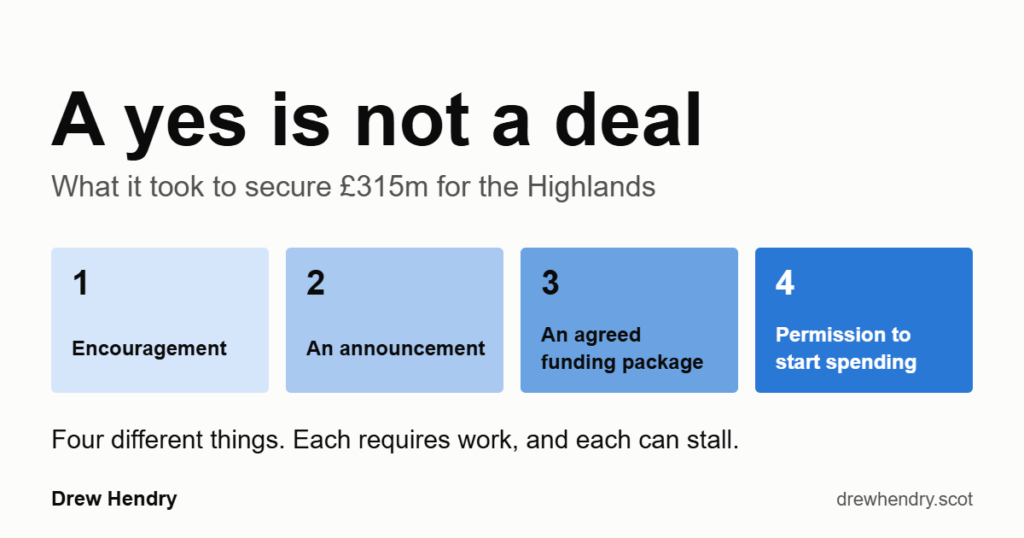
For anyone trying to get a proposal moving, that distinction matters. Encouragement, an announcement, an agreed funding package and permission to start spending are different things. Each requires work, and each can stall.
The Inverness and Highland City-Region Deal brought the Scottish Government, the UK Government and Highland Council together in a £315m package, and it took from my first letters to the Prime Minister in 2014 until 30 January 2017 to sign in full. It went on to support the Science Skills Academy, free public Wi-Fi in 15 Highland towns and the transformation of Inverness Castle, and here I set out what it took to get there.
Getting the idea into the open
The idea began during my time as Highland Council leader, through discussions at the Scottish Cities Alliance. Having heard about progress towards a Glasgow City Deal, I asked Nicola Sturgeon whether Inverness could pursue something similar. In principle, she saw no reason why not.
I subsequently discussed it with Steve Barron, the council’s chief executive. He was sceptical but supportive. I then wrote an article for the Inverness Courier setting out the ambition and the £300m figure.
That mattered to me. We had put the idea into public view. People now had something to discuss, challenge, and help develop.
Letters to the Prime Minister followed in July and November 2014. In March 2015, the council authorised further work, and the Budget announced the opening of negotiations.
Then came the general election. I won the seat from Danny Alexander, who had supported the proposal as Chief Secretary to the Treasury. The Treasury minister changed, while the full deal remained to be agreed.
Becoming the MP changed where I could make the case. It also made it my responsibility to keep pressing it.
Keeping it moving
The Scottish Government had backed the contribution I was seeking, but a full UK commitment remained outstanding. Approval for £3m of UK funding for city-centre improvements and public Wi-Fi was welcome. The wider package still needed negotiation.
In December 2015, I asked Communities minister James Wharton for progress and a timetable. In January, I asked the Prime Minister to approve the deal within weeks. In February, I returned to Wharton.
I also had conversations in corridors and at the entrance to the Commons chamber. My judgement is that persistence mattered. Ministers had to carry their support through to decisions.
That work depended on many people. Council officers, officials in both governments, delivery partners and my own office kept resolving questions and moving the proposal forward. Their contributions rarely fit neatly into a public timeline.
The eventual agreement brought together £135m from the Scottish Government, approximately £53m from the UK Government and £127m from the council and its partners. Making that package workable required business cases, delivery arrangements and clarity about responsibility. The full agreement followed on 30 January 2017.
What made it worthwhile
The Science Skills Academy is particularly personal to me. Its idea grew out of an early discussion between Dr Alasdair Munro and me about opportunities for young people across the Highlands.
We wanted them to discover what they could do in science and technology, and see a future for those talents here.
The deal secured £3m of Scottish Government funding for the Academy. That early conversation grew into Newton Rooms in Thurso, Fort William, Dingwall and Inverness, alongside a travelling facility. By June 2023, it had worked with 98% of Highland schools.
Many people made that happen. Seeing what they built from the idea gives me enormous satisfaction.
The wider investment also supported free public Wi-Fi in 15 Highland towns and the transformation of Inverness Castle into a visitor attraction. Securing the deal created opportunities that others then had to turn into practical results.
What I would take from it today
My advice is to put as much work into understanding the decision as into explaining the proposal. Who can authorise the next stage? What evidence do they need? Who will deliver it, and who carries the risk? What happens if a minister or administration changes?
An encouraging meeting should end with a clear next action, someone responsible, and an expectation of when it will happen.
I also regret not setting the ambition at £500m. With more developed projects and a better-prepared prospectus, I believe we could have made a stronger case for more. That is my judgement in hindsight, but it is a lesson about preparation as well as ambition.
At Growth for Good, we help people whose proposals have stopped moving understand those decisions and present their own case clearly. We do not sell political access. We help clients work out what progress requires.
If that sounds familiar, start a conversation at growthforgood.scot.
Read the full account, including the timeline and sources.
Related reading: What Nigg taught me about the long game, The Best Decisions Are the Ones You Can See and What determines a freeport’s legacy.
Frequently Asked Questions
£315m in total: £135m from the Scottish Government, approximately £53m from the UK Government and £127m from Highland Council and its partners.
Heads of terms were signed on 22 March 2016, six days after a Budget speech with nothing on Inverness. The full agreement followed on 30 January 2017.
Among other things, £3m of Scottish Government funding for the Science Skills Academy, free public Wi-Fi in 15 Highland towns and the transformation of Inverness Castle into a visitor attraction.
End it with a clear next action, someone responsible and an expectation of when it will happen. Then find out who can authorise the next stage and what evidence they need.
It grew out of an early conversation between Dr Alasdair Munro and me about opportunities for young people across the Highlands. It became Newton Rooms in Thurso, Fort William, Dingwall and Inverness, alongside a travelling facility, and by June 2023 it had worked with 98% of Highland schools.