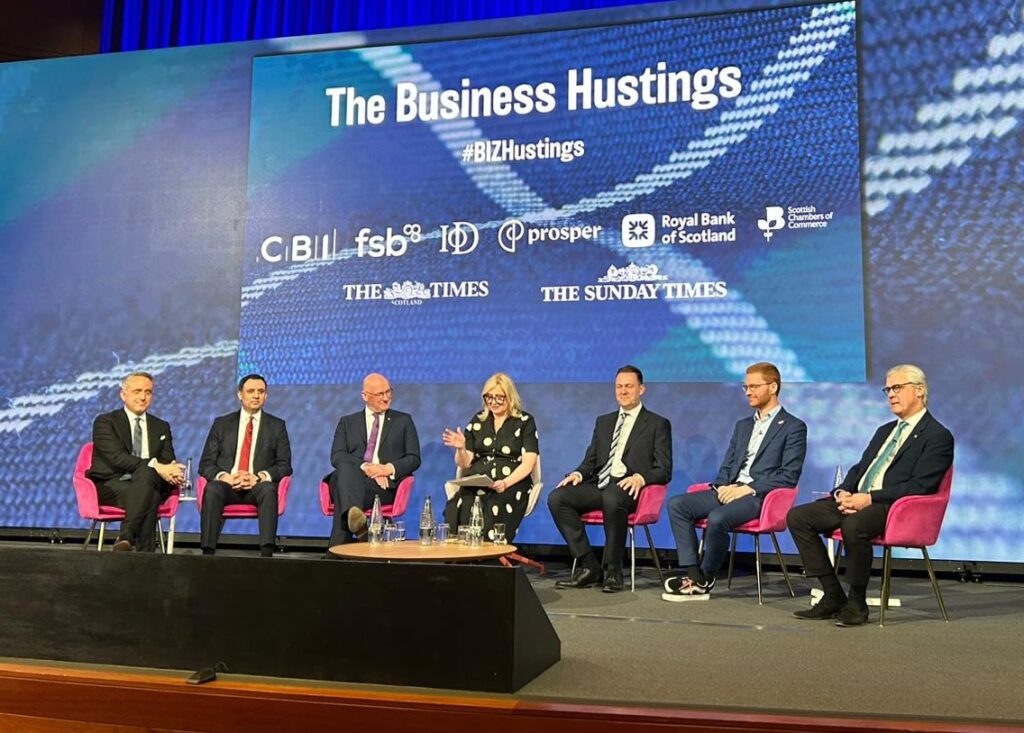
I was in Edinburgh yesterday afternoon for Scotland’s Business Hustings, the first joint hustings of the Holyrood election campaign. I’m Drew Hendry, a strategic adviser and former MP based in Inverness, and questions about the Highland economy and the Scotland election are never far from my mind. I went along as someone who thinks every day about what growth actually looks like outside the central belt. All six party leaders were on stage, answering questions from business leaders before the Holyrood election. It was a well-run event, chaired sharply by Gina Davidson, and the conversation covered a lot of ground. Energy costs. Business rates. Skills gaps. Planning reform. Women in business. Youth unemployment. Export strategy.
It was, in many respects, exactly the kind of conversation Scotland needs to be having thirty-five days out from an election.
But I left with a familiar feeling. It’s that moment when you’re in a room full of people discussing Scotland’s economy. You suddenly realise that the part of Scotland you come from, and the people you see every day, aren’t really there at all. Even though there were a number of us in attendance.
The Highlands and Islands got one meaningful mention across the whole session. It came during the discussion on women in business, when a questioner from the Highlands, someone I know well, Jill McAlpine, made the point that the market failure in women-led enterprise is especially acute in rural communities and the Highlands. She was right. And it was a good moment. But the panel moved on, and the Highlands didn’t come back.
What the Highlands Actually Brought to the Room
That’s not a criticism of the organisers or the panel. It reflects something deeper. When Scotland’s political and business leaders meet to discuss growth, they usually focus on the central belt. The planning problems they discuss are those in Glasgow and Edinburgh. They want to build skills pipelines for industries mainly located between the M8 and the commuter towns of the central belt. The housing shortage they’re worried about is, again, broadly a central belt problem, or at least that’s how it gets discussed.
None of that is wrong. Those are real problems that deserve serious attention. But Scotland’s economy doesn’t stop at Stirling.
The Highland Economy and Scotland’s Election Blind Spot
There were moments in the room where the Highland dimension was right there, waiting to be picked up, and wasn’t. Points were made about industries Scotland should be building towards, including data centres, renewables and defence, that won’t be based in the central belt. They’ll be in remote and rural places, close to the wind farms, the coastline and the infrastructure those sectors need. But nobody pushed the obvious follow-up: so what does the skills pipeline look like for those communities? Where do those workers live? What does the planning system need to look like when the investment is happening in Caithness, not Cambuslang?
The best part of the afternoon was when someone shared a place-based model for apprenticeship. It focuses on being patient, grounded in the local area, and centred on the skills and strengths of a specific community. It was exactly the kind of approach that rural and Highland economic development requires. But it was offered as an example of good practice, not as a template for a national approach to the communities that will actually host the energy transition.
The cost pressures facing Highland businesses are real and compounding. Business rates are part of the picture, which is quite complex. The small business bonus scheme offers significant relief, helping many smaller operators. However, there are valid concerns about how reassessments have affected others. But rates are only one layer. The UK Government’s rise in employer national insurance contributions hit businesses hard. They were already dealing with higher energy costs, rising input prices, and the costs of remote operations. For a Highland business, those pressures don’t arrive one at a time. They arrive together, on thinner margins, with fewer mitigation options.
The Real Cost of Running a Highland Business
This is not a complaint about the hustings. It is a look at where the Highland economy sits in Scotland’s political view, five weeks before a Holyrood election.
The issues are not obscure. The skills shortage in social care, construction, and technical trades is worse in Highland communities. This is because there are fewer people to recruit and not enough housing for workers. The planning system’s slowness costs Highland businesses more. They have less room for delays due to their scale and distance from the supply chain.
The energy transition is Scotland’s big economic chance, as everyone on stage agreed. It will mainly rely on Highland land, coastline, and infrastructure. The communities that live with the turbines, cables, and substations should not be an afterthought in the growth story. They should be central to it.
There is a straightforward agenda here, and it doesn’t require a new policy framework, a new agency, or a new conversation. It requires the people making decisions about Scotland’s economic future to ask, at every turn, what this looks like in Inverness. What does it look like in Thurso, in Portree, in Aviemore, in Fort William? Is this policy going to work the same way when broadband is slower, the workforce is smaller, the roads are longer, and the margins are thinner?
If the answer is no, and often it will be no, then the policy needs to be different. Not watered down. Different.
Scotland has an election in five weeks. The manifestos are being written now. This is the moment to make the case that a Highland economy that works is not a regional interest story. It is a test of whether Scotland’s growth ambitions are real or, once again, a central belt story told in national terms.
I’ll be watching the manifestos closely. I’ll be asking those questions. And I’d encourage every Highland founder, business leader and community builder to do the same.