There are times in economic policy when details matter more than headlines. The Scottish Government’s Air Departure Tax consultation ends tonight. This is one of those times.
The headline is mostly positive. ADT will replace Air Passenger Duty in Scotland from April 2027. The proposed exemption for the Highlands and Islands keeps the tax-free status for flights between Highland airports and the rest of the UK. For island communities, where air travel is essential, this retention is crucial.
However, a significant change is hidden in the details and needs more public attention. The proposal to remove the international exemption, including for connecting flights, could reverse years of progress in Highland connectivity.
What is actually changing
Since 2001, all flights from Highlands and Islands airports have been exempt from Air Passenger Duty regardless of destination. That means a passenger flying Inverness to Heathrow and then connecting to Amsterdam, Dubai, or New York has paid no tax on either leg of that journey.
Under the proposed ADT regime, that changes. International flights and connecting flights to international destinations become fully taxable. The domestic leg to a UK hub airport remains exempt if booked separately, but most passengers do not book separately – they book a through ticket precisely because it provides security of onward connection, baggage transfer, and protection if the first flight is delayed.
The practical consequence is that the most common way Highland business travellers and tourists reach international destinations becomes more expensive overnight.
Why Inverness is not Edinburgh
The Scottish Government says this change aims to create fair treatment for international travel at Scottish airports. This goal makes sense. However, equal tax treatment does not guarantee equal outcomes, and this distinction is crucial for the Highlands.
Edinburgh Airport serves over a million people and offers many direct international flights. In contrast, Inverness Airport serves about a quarter of a million people, has fewer domestic flights, and limited international options. Its Amsterdam service, a key route, operates on thin margins and relies heavily on demand.
Applying the same tax rules to both airports does not ensure fairness. It treats unequal situations the same and worsens existing disadvantages. The principles behind the City Region Deal, the Green Freeport, the Air Discount Scheme, and Highland economic policies emphasise that equal outcomes require tailored treatment in different contexts. Removing the international exemption ignores this principle where Highland airports need support the most.
The investment case
This matters more than just the cost to passengers. The Highlands is at a vital economic moment. The Green Freeport is starting up. HIE has approved major investments at Ardersier Port and Arnish. Businesses are now looking at the Highlands for opportunities in offshore wind, renewable energy, and related fields.
These businesses will examine international connectivity from Inverness. They want to know if they can fly to European business centres. They need efficient connections to long-haul routes. Moving people and ideas in and out of the region is crucial for investors. These are often the first questions they ask.
A decline in international routes at Inverness, caused by a tax change that raises costs and lowers demand, sends the wrong message at the worst time.
The subsidy control question
It would be unfair not to acknowledge the complexity of the Scottish Government’s position here. The reason the international exemption is being removed is not indifference to Highland connectivity. It is a genuine legal concern about subsidy control compliance – the risk that retaining the exemption in a new legislative framework could open it to challenge in ways that the existing APD exemption was not exposed to.
That is a real problem and it deserves a real solution. The HITRANS response to the consultation points to equivalent measures in other EU countries and Norway that provide regional aviation support without falling foul of equivalent rules. These precedents suggest that a compliant solution exists and that the task for the next Scottish Government is to find it, working with HITRANS, HIE, HIAL and Highland Council, rather than accepting the removal of the exemption as the only available option.
What the next government needs to commit to
The pre-election period that begins now creates a clear opportunity. The parties seeking to govern Scotland from May should be asked directly what they will do to protect Highland international air connectivity under the ADT framework.
The ask is not unreasonable. It is not to abandon the ADT project or to reject the principle of tax reform. It is to commit to three specific things.
First, to work actively to find a subsidy control compliant mechanism that retains the international exemption for Highland airports before the April 2027 implementation date.
Second, if that cannot be achieved in time, to maintain the current APD exemption for Highland international flights during a transition period while the compliant solution is developed, rather than implementing the harmful change and attempting to remedy it later.
Third, to commission and publish independent monitoring of the impact of ADT on Highland route viability and passenger numbers from the point of implementation, with a commitment to rapid policy response if adverse effects are identified.
None of this requires abandoning the broader ADT framework. The domestic exemption, the extension to inbound legs from Scottish airports, the private jet supplement – all of these can proceed as proposed. The international exemption is the specific issue that needs to be resolved and it is the specific issue that the next government must have a clear answer to.
The routes are worth fighting for
The air routes that exist from Inverness today were not given. They were won through years of sustained advocacy, targeted support, and a long-term commitment to making Highland aviation viable. Every time a route was threatened, communities and businesses mobilised to defend it. Every time a new service was secured, it was the product of a collective argument that the Highlands deserves connectivity comparable – never identical, but comparable – to the rest of Scotland.
The ADT consultation has landed in the pre-election period almost by accident of timing. But that timing is also an opportunity. The parties standing for election in May should tell us clearly what they will do to protect what the Highlands has built. The routes from Inverness to Heathrow, to Amsterdam, to the connections that link this region to the world – they are part of the economic infrastructure of the Highlands in the same way roads and broadband are part of it.
They are worth fighting for. And the next Scottish Government should be prepared to say so.
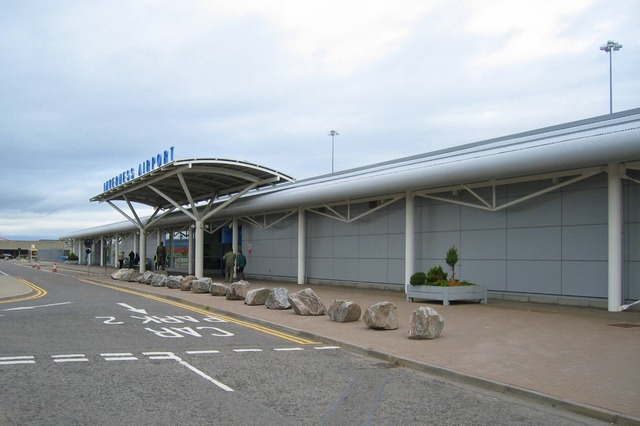
Featured image: John Allan / Inverness (Dalcross) Airport, via Wikimedia Commons. Licensed under Creative Commons.