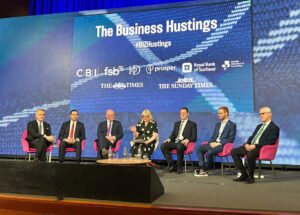
Declan Ramsey is the founder of DramCo_, a business that provides fractional business solutions to small and medium-sized businesses across Scotland. DramCo_ specialises in structuring firms, helping them to make sense of and build the operational foundations they need before, during and after their first hires, the systems, structures and leadership clarity that turn ambitious decisions into actual momentum.
Declan brings a practical, evidence-led approach to a problem most founders only discover when they are already inside it. His work sits at the intersection of people, process and performance, and his thinking draws on direct experience of what it takes to build teams that actually hold together under pressure.
He is a regular contributor to conversations about small business team building and sustainable growth across Scotland, and joins the Growth for Good platform as a guest contributor.
Guest contributor: Declan Ramsey, DramCo_
Small business team building is one of the most consequential decisions a founder in Scotland will make – and one of the most misunderstood. Growth arrives as pressure first. More enquiries, more orders, a fuller diary, more demand than one person can carry. The obvious answer seems to be hiring: another pair of hands, someone to take work off the plate. The problem is that the first hire rarely lands in a business that is fully ready for them.
That is one reason so many firms stay small for longer than they had hoped. At the start of 2025, 75% of UK private sector businesses did not employ anyone beyond the owner and small businesses with 0 to 49 employees still made up 99.18% of all UK firms, with Scottish figures at 99.30%. Small firms are everywhere in the economy, but most never build far beyond a very lean model.
The five-year picture is even more sobering. According to the ONS, only 39.4% of UK businesses born in 2018 were still operating in 2023. That figure does not prove hiring is the only reason firms stall or fail, but it does show how unforgiving the early years of growth can be when cash is tight and every people decision carries weight.
Growth creates pressure before it creates structure
This is where small businesses face a difficult trade-off. Their available funds often do not buy the level of skill they actually need. They buy what feels affordable in the moment.
On paper, that can look sensible. Hire a junior. Keep costs down. Train them up over time.
In practice, that decision can create a second layer of strain. Less experienced hires usually need clearer processes, stronger management, better onboarding and more day-to-day direction. None of that is a problem in itself. It only becomes a problem when the business has not built the structure around them. Instead of relieving pressure, the new person absorbs time, creates inconsistency and often delivers a slower return than expected.
Why a new hire does not always solve the problem
That pattern is not just anecdotal. Government evidence shows that firms with 2 to 4 employees face some of the steepest hiring challenges in the market. In 2022, 42% of their vacancies were hard to fill because of skill shortages, compared with 35% for large firms. In the same evidence review, 15% of all firms reported at least one employee not being fully proficient in their role, and the impact of one under-skilled person is likely to be felt more sharply in a smaller business.
What small budgets really buy
Then there is the cost side. The Federation of Small Businesses found that 46% of small business employers ranked labour costs as a top barrier to growth. The British Business Bank has also noted that high borrowing costs and risk aversion are major factors behind weak investment among smaller businesses, with much of the recent increase in lending going towards working capital and cashflow rather than growth investment. In other words, many small firms are using precious funds to keep the engine running, not to build the management capacity, systems and support that sustainable growth actually depends on.
The real issue is the ecosystem around the role
That is the real issue. The risk is not simply hiring the wrong person. The risk is bringing someone into an ecosystem that does not support them properly.
If the role is unclear, the handovers are inconsistent, the priorities change daily, and the knowledge sits in the founder’s head, even a good hire can underperform. Not because they lack potential, but because the environment around them is doing too much of the work badly. Onboarding becomes patchy. Accountability becomes blurred. Training happens on the fly. Progress depends on goodwill rather than structure.
And when that happens, return on investment slips quickly. The wage goes out every month, but the contribution takes longer to appear.
The businesses that scale more effectively tend to understand something important. People are not the whole answer. People need a system around them. Leadership, clarity, process, rhythm and realistic expectations are what turn salary cost into business value.
This matters because better structure is closely tied to better performance. The government’s SME evidence annex points to leadership and management practices as major drivers of productivity, citing ONS work that found a 0.1 point increase in management scores was associated with a 9.6% increase in productivity. The same evidence review shows that firms providing training are more likely to report improved employment and turnover outcomes, yet only 32% offer management training and 33% offer supervisory training.
That lands particularly sharply with Scottish business owners, where SMEs account for 99.30% of all private sector businesses, meaning this is not a fringe issue, but a very common reality for founders and owner-managers across the country. For Scottish business owners, the sting of a poor hire or a weak operating model is often felt faster and more personally, because there is less room for wasted time, wasted money and slow returns.
Why fractional teams can bridge the gap
This is where fractional business solutions add value. They give small businesses access to experienced operational capability without the immediate commitment of multiple senior hires, helping to put clearer systems, responsibilities and working practices in place. That matters not only for businesses preparing to grow, but also for those that simply want to run better, make wiser use of their people and build on stronger foundations.
That change in approach brings additional value for every future hire. Instead of dropping people into a pressure pot and hoping they cope, the business gives them a framework in which they can contribute, develop and stay.
Because the difference between a business that grows and one that stays stuck is not always effort, ambition or even demand. Often, it is whether the systems, support and leadership around the team are strong enough to turn hiring into momentum, rather than risk.
“To affect where your business is going, you must scale with continual effect, not just hopeful intent.” – Declan GR Ramsey
Sources
- Office for National Statistics, Business demography, UK: 2023
- Department for Business and Trade, Business population estimates for the UK and regions 2025
- Department for Business and Trade, Backing your business: evidence annex
- Federation of Small Businesses, Response to the Low Pay Commission
- British Business Bank, Small Business Finance Markets Report 2025
- Scottish Government, Businesses in Scotland: 2024, Business Size
Email: declan@dramco.uk | Phone: 01463 353993