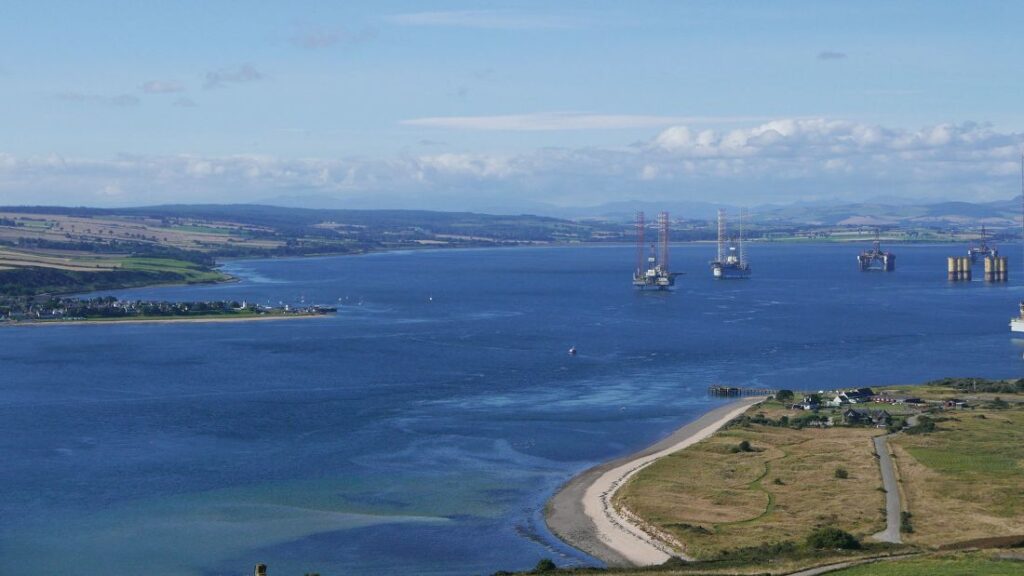
A freeport’s legacy in the Highlands is never decided by the day it opens, or by the executive appointed to run it. It’s decided by what’s still standing in the businesses around it five or ten years after the ribbon gets cut: whether the accountant, the childminder, the transport firm and the apprentice actually got something out of it, or whether the benefit stopped at the factory gate and the tax site boundary. That’s the only test that actually holds up, and it’s the one most freeport coverage skips.
The claim worth testing
Alison Wilson, the new managing director of the Inverness and Cromarty Firth Green Freeport, made a version of that argument in a keynote at the Highland Business Women Awards, though hers came framed as a description of her first weeks in the job rather than a stated commitment to legacy. She has spent that time in boardrooms, on quaysides, in workshops, offices and cafes, meeting business owners, apprentices, investors, civil servants and community leaders, and come away arguing against the usual way the Inverness and Cromarty Firth Green Freeport gets talked about. The headlines are about new factories and international companies choosing the Highlands. Behind them, in her words, are “hundreds of businesses and thousands of people”: accountants, engineers, transport firms, hospitality businesses, childcare providers, family companies that have been part of their communities for generations. Investment, she says, “doesn’t stop at the gates of a port or a tax site.” It’s close to the question I raised when the Green Freeport first launched: potential is not outcome.
The evidence behind the speech
That’s a claim worth testing rather than just quoting, and it was already showing signs of being backed with something more concrete than a speech. The same week Wilson spoke, a £2 million Workforce North Co-Investment Fund opened for applications, running from 1 September to 30 October, administered by Highland Council and anchored by Skills Development Scotland, built specifically to help Highland employers get apprenticeships and skills pipelines in place ahead of an expected £100 billion of investment across the region over the next decade. It lands on exactly the skills gap I flagged after this year’s Business Hustings, where the Highlands barely came up at all. That fund is what the ripple looks like before it becomes a headline: money aimed at the accountant’s firm, the transport company, the childcare provider, not the factory gate. It’s the unglamorous, practical proof that the legacy question is being taken seriously in practice, not just answered well in a speech.
Whether that holds for the next ten years is genuinely still open. What’s less open to question, if her own account of getting the job is anything to go by, is what kind of person tends to end up doing the unglamorous work that legacy actually requires.
An unplanned path to the top job
Wilson didn’t set out to run the Inverness and Cromarty Firth Green Freeport. At the start of this year she was its investment and development manager, happy in that job, juggling work with helping to care for her elderly father, not looking for a next step. Then, within weeks, her father died and Calum Macpherson, managing director of the Inverness and Cromarty Firth Green Freeport, announced he was moving on. The top job was suddenly open, and nobody had asked her whether she wanted it. She told the awards audience she questioned whether she was capable, whether she was ready, and, in her own words, “did I actually want it? Not should I want it, did I want it?” She had assumed that by this stage in her career she would have stopped asking herself questions like that. She hadn’t. She applied anyway, and was appointed last month.
Doing it as herself
She told an older story too, from twenty five years ago, a young working mother going straight from a nursery drop off into a client meeting and only realising halfway through that her toddler had left his mark on her suit. She remembers slipping out of business dinners to phone home from the toilets and say goodnight to her kids before they slept, hoping nobody noticed she had gone. What she has taken from both stories into the new job: “I didn’t have to become some different version of myself to take on this job. I could just do it as me.”
The actual legacy test
That matters for the legacy question, not as a separate story sitting next to it. The businesses that actually build something lasting in a place are rarely run by the people who arrived by the tidiest route. They are run by people who took an opportunity they had not planned for, at a moment that was not convenient, and did the work anyway without pretending to be someone else. Wilson grew up in the Highlands in the 1970s and 80s being told a real career meant leaving, and she left, like many of her generation did. She came back because it is home, and she is now watching her own grown up children build careers here without having to make that choice.
That last point is the actual legacy test, stated plainly rather than left as a sentiment. It will not be settled by this year’s investment figures, or by how the appointment story reads. It will be settled by whether funds like Workforce North keep landing behind the headline investments for the full ten years this is meant to run, and by whether the Highlands still has an accountant’s firm, a childcare provider and a transport company standing behind whatever gets built at the Inverness and Cromarty Firth Green Freeport, long after the people who opened it have moved on.
Sources: Rachel Smart, “New Inverness & Cromarty Firth Green Freeport boss opens up on unexpected path to top job,” Inverness Courier, 4 September 2026, drawing on Alison Wilson’s keynote speech at the 2026 Highland Business Women Awards. Additional source: Highlands and Islands Enterprise, “Innovative pilot fund to boost workforce growth across Highlands and Islands,” 2 September 2026.