As a Highland advisor and former MP, I have watched this region generate wealth for Scotland while too many of its communities bear the costs without capturing the benefits. The Highland energy transition and the question of community benefit sit at the centre of what the new Scottish Government must now decide. As a Highland advisor and former MP for Inverness, Nairn, Badenoch and Strathspey, I have spent years watching what promises get made and which ones get kept. What follows is my perspective on what this new mandate must actually deliver for the Highlands – and for the people building things here right now.
The SNP has won a new mandate. Ministers are being appointed, officials briefed, and Scottish public life is shifting as it does every five years. For anyone who has watched the Highlands from the inside, this is a moment of genuine possibility. Not because the policies are missing. The strategies are mostly written. The consultations are mostly complete. What this administration has the chance to show, from day one, is that it was elected to lead. That means making decisions, seeing them through, and backing the people already taking risks.
We talk a lot about collaboration and cooperation in Scottish public life. These are good words. They describe important things. But they cannot exist without ambition and leadership, and pretending otherwise never serves us well. Collaboration without leadership is a room full of people agreeing politely while nothing moves. Cooperation without ambition is a process that produces a report. Underneath the language of partnership lies an institutional culture genuinely afraid of making mistakes. It has been there throughout our lives. It runs from personal decisions through corporate boardrooms to policy chambers, and it is heightened by 24-hour news and social media.
Every misstep is treated as proof of incompetence. The seemingly smart move is to avoid taking a strong stand. The outcome is clear: agreement without action, nice words without results, and risks managed so tightly that nothing important gets done.
Facing up to these matters in the Highlands more than most places, because the Highlands has been bearing a particular burden for a long time. It generates 27% of Scotland’s renewable energy. Its residents deal with some of the highest energy costs in the UK, and one in three households still faces the choice between heating and eating. Infrastructure is hosted here. Transmission lines, wind farms, and land-based water catchments. Local communities do not own them and most often did not choose to host them. The risk lands locally. The benefit flows elsewhere. This is not a policy failure at the margins. It is a structural imbalance that has been accepted as normal. This is the context in which Highland Energy’s transition community benefit must be understood.
And then there is the quieter loss, the one that never appears on any balance sheet. Every Highland family has watched someone leave. My own two sons are among them. Some of this is the natural pull of other places. Cities shine, and young people move towards the light. That is not something to be argued with. But it is not always the cause. Some of it is the absence of conditions that would have made staying a serious choice.
What the Highland energy transition community is already building
Consider Callum Mackintosh. Callum left school in the Highlands at fifteen, knowing he wanted to work in plant and construction. The apprenticeship he needed did not exist in Scotland, nor anywhere outside the very south of England. He would have to travel to Norfolk to get it.
He chose to be the exception; he stayed in the Highlands, entered the construction industry and went on to build Highland Hammer Hire into a successful business. Now he leads Hi-Skills, a planned national infrastructure skills centre in the Highlands that would train 1,800 people a year in the specialist trades Scotland has to import: plant operation, cranes, scaffolding, formwork. The trades that build things.
Callum could have pursued this commercially. He chose a community interest company structure because he thinks the benefits should go to the industry and the communities it serves, not to him. The project is shovel-ready. The private funding is there. The industry wants it. The bottleneck, as it so often is, is planning and permissions. Callum is doing exactly what Scotland says it wants more people to do; in exactly the way policymakers say they want it done. The question is whether the system can get out of its own way fast enough to let it happen.
He is not alone. Highland CIC launched their manifesto ahead of the election. It shows, with strong evidence, how the Highlands helped the UK’s energy transition but did not get the economic benefits that should have come. It presents a practical plan to keep and reinvest that value locally. Yvonne Crook, the chair, has spent years building the partnerships and credibility behind this work. Her phrase is worth repeating: “The Highlands has the leadership, the ambition and the vision. What it needs is a commitment from the new Scottish Government to a model that finally delivers for the communities hosting the transition. It is, as she says, a matter of fairness.”
This is the pattern. Callum at the individual level and Highland CIC at the regional level are making the same argument. The ambition exists. The plans exist. The leadership exists. What is needed now is the willingness at the centre to move at the pace and with the seriousness these opportunities deserve. The Highland energy transition community has the leadership. What it needs now is the political will to match it.
What does community benefit mean for Highland renewable energy projects?
The Highlands generates 27% of Scotland’s renewable energy and hosts the infrastructure that carries it to the rest of the country, yet current arrangements mean most of the economic value flows elsewhere while local communities carry the costs. Genuine community benefit would mean Highland communities and local businesses receiving a fair, structural share of that value – not a discretionary goodwill fund, but an entitlement built into how projects are approved and delivered. Highland CIC’s manifesto sets out a practical plan to keep and reinvest that value locally rather than exporting it. As the CIC’s chair, Yvonne Crook, has put it, the region already has the leadership, the ambition and the vision. What is missing is a Scottish Government commitment to a model that finally delivers for the communities hosting the transition. As she says, it is a matter of fairness.
What the new Scottish Government must do now
None of this is an argument against consultation. Good consultation matters, and both sides often put genuine thought into it. The problem arises when asking a question becomes a way of avoiding an answer.
The new ministers taking their seats inherit a Scotland rich in potential, much of it here in our region. The Green Freeport. The renewables pipeline. A tourism sector ready for investment. Young people who want to build something in the Highlands, if the conditions are right. Bold commitment shows results: the University of the Highlands and Islands, the A9 dualling programme, and the Inverness City Region Deal are clear examples. Big commitments, some harder fought for than others, but vital interventions that show what is possible when government decides to move.
This is not a moment for managed caution. The Highlands is not a region to be administered. It is a contributor whose contributions have been consistently undervalued, and there are people here ready to build something extraordinary if given the space.
The new government has the mandate. The work is waiting. The invitation is open.
If your organisation is weighing up how to respond to this, that’s the kind of conversation Drew’s Place-Based Economic Development Support work is built around.
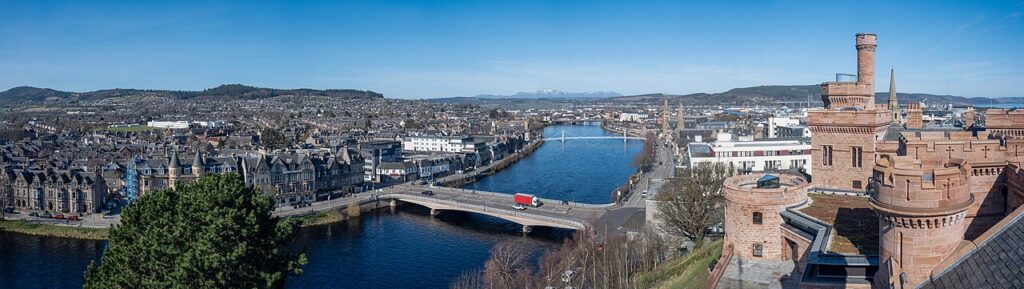
Photo: Panoramic view of Inverness. Photo: Lucas Kendall, Wikimedia Commons. Licence: CC BY-SA 4.0.